


Share


Summary
The 14U and 16U years are where volleyball development starts to become more intentional. Athletes can begin specializing by position, but they still need to develop as complete volleyball players. At the same time, players should begin taking greater ownership of their recovery, physical development, decision-making, and mentality.
Stanford head coach and national championship-winning coach Kevin Hambly breaks down what matters most at this stage: finding the right balance between general and position-specific training, developing volleyball IQ, learning through failure, and creating practices that challenge athletes at different levels.
This guide turns Hambly’s philosophy into practical coaching priorities for developing better 14U and 16U volleyball players.
For a full breakdown of Kevin’s insights, please visit Sports Imports.
Developing Your Game Starts at 14U
At 10U and 12U, the focus is on building the foundation: learning the skills, getting plenty of touches, becoming comfortable with the ball and developing a love for volleyball.
At 14U and 16U, that foundation should start turning into a more complete understanding of the game.
Players are getting stronger and more physically mature. Positions are becoming more defined. Systems and competition become more important. And athletes can begin taking more responsibility for how they train and prepare.
That doesn’t mean abandoning the principles that mattered at younger ages.
According to Hambly, this stage is about adding layers: beginning to specialize while continuing to develop complete volleyball players, introducing more decision-making while continuing to develop fundamentals, and helping athletes learn how to handle both success and failure.
The goal is to develop players who aren’t just better at their position, but better at playing volleyball.
Explore more of Hambly’s approach to developing your game in Kevin’s Corner.
Downloadable Coaching Resources
Before diving in, download these free resources built to help coaches structure more effective 14U and 16U practices.
Free Downloads
• 14U/16U Training Blueprint (PDF)
• 14U/16U Practice Template (PDF)
The Transition From Complete Player to Specialized Player
One of the biggest changes at 14U is that athletes can begin specializing by position.
Players can start learning what it means to be a setter, middle, outside, opposite, or libero. But Hambly believes coaches should be careful about deciding too early that a player will always play one position.
Athletes are still developing physically, and a 14-year-old’s body can change significantly over the next several years.
“I think you want to start specializing at the 14 and under, but you also want to continue to teach them all the skills.” — Kevin Hambly
That means finding a balance between specialization and versatility.
A middle should still learn to pass. An outside hitter should be comfortable setting a ball. A setter should be able to attack. All players should continue developing their ability to handle the ball and play defense.
The goal isn’t to prevent specialization. It’s to make sure specialization doesn’t limit development.
Specialization Shouldn’t Mean Becoming a One-Dimensional Player
Volleyball rarely goes exactly according to plan.
A middle may have to take a short serve. An outside hitter may have to set a high ball. A setter may have to attack an overpass. Any player may have to chase down a difficult ball and keep it high enough for their team to continue the rally.
Hambly believes athletes need to be prepared for those situations.
“Every one of my players was probably in middle on their club team at some point.”
That’s why even specialized players should continue working on the complete skill set.
By 16U, players should have a primary position and a better understanding of their role, but they should still be capable of handling situations outside of it.
Specialize in your position. Don’t stop being a volleyball player.
Recovery and Physical Development Start to Matter More
As athletes move through 14U and 16U, they also need to start taking better care of their bodies.
Recovery, hydration, nutrition, mobility, and general physical preparation become increasingly important as training and competition demands increase.
Hambly recommends that athletes around 15 or 16 begin incorporating more general strength and conditioning work, even if that starts with basic bodyweight exercises. Squats, plyometrics, and landing mechanics can help athletes learn how to move and prepare their bodies as they become stronger and heavier.
This isn’t about turning young athletes into full-time weightlifters. It’s about teaching them that development happens outside of volleyball practice, too.
Taking care of their bodies becomes part of becoming a better volleyball player.
Balancing General Skills and Position-Specific Training
As specialization increases, coaches have to decide how much practice time should remain dedicated to general volleyball skills.
Hambly recommends gradually shifting that balance rather than making a dramatic change.
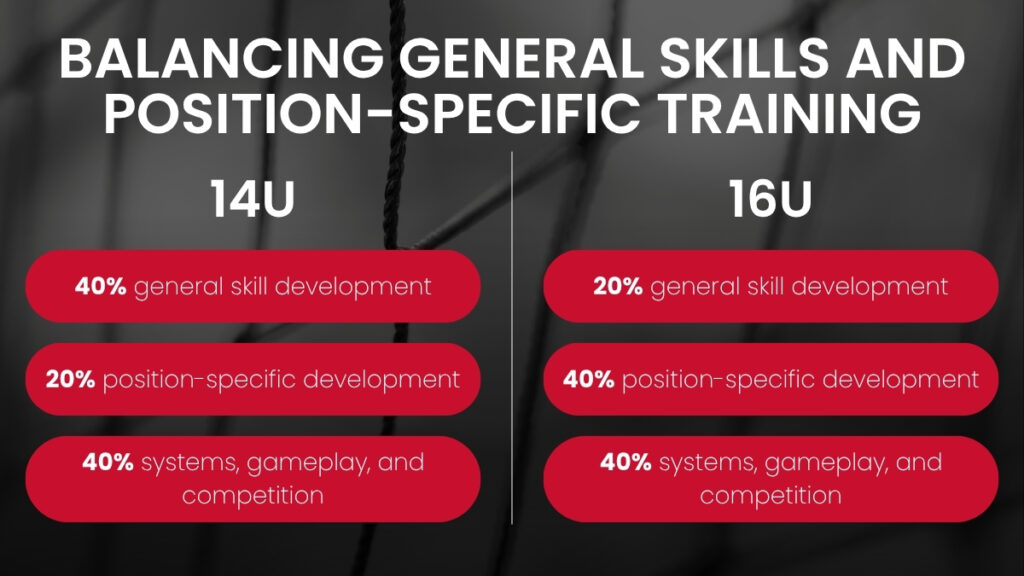
At 14U, he suggests roughly:
• 40% general skill development
• 20% position-specific development
• 40% systems, gameplay, and competition
As athletes progress toward 16U, those percentages can gradually flip.
By 16U, the emphasis might look more like:
• 20% general skill development
• 40% position-specific development
• 40% systems, gameplay, and competition
The exact percentages aren’t the important part. The progression is.
Players should increasingly learn how to play their position while continuing to serve, pass, set, attack, defend, and handle the ball. In fact, Hambly says his teams sometimes have to spend additional time on general skills because athletes didn’t get enough of that foundation when they were younger.
Specialization should increase with age, but general skill development should never disappear.
The Skills Every 14U and 16U Player Should Develop
If Hambly had an athlete for an entire season, he would want them to become proficient in the skills they need to play their position while remaining comfortable outside of it.
Players should be able to:
• Serve effectively, including developing different types of serves
• Pass and control the ball
• Set when necessary
• Attack a high ball
• Play defense
• Create angles
• Handle difficult or off-system balls
• Play the ball high to the middle of the court
• Make smart decisions when a play breaks down
The ability to handle those situations matters because the game doesn’t always follow the system.
“In every match that I’ve ever played in, in a big moment, there’s been a big moment where a middle has to set a high ball.” — Kevin Hambly
The more situations players can handle, the more prepared they are when those situations actually happen in competition.
What Separates Great Players? Mentality
At 14U and 16U, physical differences can become obvious. Some players are taller, faster, stronger, or more explosive.
But Hambly believes physical ability isn’t what ultimately separates the best players. It’s mentality.
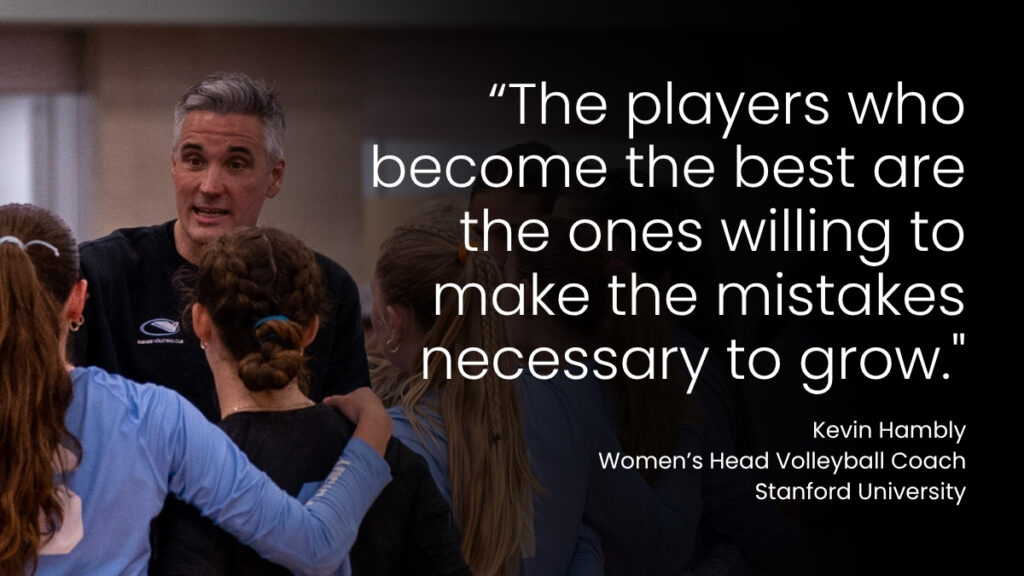
“What separates the great athletes is mentality and like work ethic and their willingness to make the mistakes necessary to grow and to push themselves.” — Kevin Hambly
The best players are willing to get uncomfortable. They’re willing to make mistakes, accept coaching, try something difficult, and continue pushing themselves when they’re no longer the best athlete in the gym.
A player who has always succeeded because they’re more athletic may struggle when everyone around them becomes bigger, stronger, and faster. That’s when mentality starts to matter.
Hambly says some of the players who rise the most are those who are willing to make mistakes and make changes.
Athleticism may separate players early. The willingness to learn can separate them later.
Teach Athletes to Learn From Failure
At this age, coaches should also help athletes change how they think about mistakes. Hambly’s approach is simple:
“An error is information.” — Kevin Hambly
If an attacker gets blocked, that’s information. If a hitter keeps attacking the middle-back defender and getting dug, that’s information. If a player hits a low set out of bounds, that’s information.
The question becomes: What did you learn, and what can you do differently next time? Hambly describes this as a true growth mindset. He makes an important distinction between simply working hard and actually learning from failure.
A growth mindset means taking every success and failure as an opportunity to learn, adjust, and improve.
“Failure is so important.” — Kevin Hambly
That also means coaches need to create environments where athletes are allowed to fail. If players are never challenged enough to make mistakes, they may not be pushing themselves enough to grow.
Coaches Need the Same Growth Mindset
The same principle applies to coaches.
When things aren’t going well, it’s easy to react emotionally. But yelling, getting frustrated, or immediately telling an athlete what they did wrong doesn’t necessarily teach them how to make a better decision next time. Instead, coaches can use mistakes as teaching opportunities.
If an athlete makes a poor attacking decision, ask what other options were available. If they make the same mistake twice, help them identify what they can look for the next time they’re in a similar situation.
“If we’re saying to the athletes every mistake we make is an opportunity to learn, then I need to look for every mistake, what can we teach?” — Kevin Hambly
The coach’s job isn’t to eliminate mistakes. It’s to help athletes learn from them.
Developing Different Players in the Same Gym
One of the challenges at this age is that athletes don’t all develop at the same rate. What happens when half the gym can execute a drill and the other half can’t? How do you challenge your best players without leaving everyone else behind?
Hambly believes good drill design can solve much of the problem.
Instead of creating completely separate practices for different skill levels, coaches can use game-like drills where athletes have different individual focuses. For example, an experienced middle might be working on reading an attacker and taking away a specific angle, while a newer player is simply focused on getting into the correct position and reading the set. They’re doing the same drill, but the coach is giving each player something appropriate to their development.
“You’re teaching the individual inside the team concepts.” — Kevin Hambly
That requires coaches to know what each athlete needs and avoid trying to teach everyone everything at the same time.
Build Decision-Making Into Practice
At 14U and 16U, athletes should begin moving beyond simply executing skills and start thinking about why they’re making certain decisions. Attacking is a simple example.
Instead of always giving an outside hitter the same type of set and asking them to swing, coaches can change the situation.
• What should the hitter do with a perfect set?
• What about a set that’s too far off the net?
• What if the ball is low?
• What if the defense is already positioned where they want to attack?
Those situations force athletes to make decisions instead of simply repeating a movement. The goal is to teach athletes how to use their skills to solve problems.
Develop Volleyball IQ by Teaching Players to Read the Game
Volleyball IQ develops through experience, but coaches can help athletes learn what to watch for. Hambly teaches players to focus on the decision-makers rather than simply following the ball.
• After the pass, the setter becomes the decision-maker.
• Once the ball is set, the attacker becomes the next decision-maker.
Players should begin recognizing who is making the next decision, what options are available, and where they need to position themselves based on what is most likely to happen.
Reading the game isn’t just reacting faster. It’s recognizing the situation early enough to get into position before the play happens.
“A lot of what reading is, is really just reading the situation, understanding the situation, and then anticipating what the potential options are, and putting yourself in position to take care of all those options.” — Kevin Hambly
The more situations athletes experience, the more those decisions become instinctive.
What Does a High-IQ 16U Player Look Like?
A high-IQ player often stands out because they’re simply in the right place more often. They understand where the ball is likely to go. They recognize situations. They anticipate options. They position themselves before the play develops.
“When they have a high IQ, they put themselves in places where the ball’s going to be the most.” — Kevin Hambly
That’s one reason Hambly believes game-like training is so important. Players develop volleyball IQ by repeatedly experiencing situations, making decisions, making mistakes, and adjusting. And playing athletes outside their normal positions can accelerate that learning. A middle playing back row or an athlete playing outside of their normal position may make mistakes, but those mistakes can teach them about positioning, decision-making, and how the entire game works.
Use Game-Like Drills to Develop Real Volleyball Skills
One of Hambly’s go-to examples is what he calls 6-0 volleyball.
Players rotate through positions and everyone plays everything. A middle may have to play back row. A defensive specialist may be asked to block. Players may be required to forearm set.
Hambly has used versions of this drill with youth teams, his 17U club team, college teams, and national-level athletes because it creates situations that actually occur in matches. For example, a middle may eventually have to set a high ball. A setter may have to attack an overpass. Any player might have to chase down a ball and keep it high enough for their team to swing.
Game-like drills expose athletes to those situations before they happen in competition. They also give coaches opportunities to teach skills, positioning, decision-making, and systems at the same time.
Keep Players Focused on One Thing at a Time
One of Hambly’s simplest coaching principles is that athletes shouldn’t be asked to focus on everything at once.
“An athlete can only focus on one thing.” — Kevin HamblyIf the focus of a drill is defensive positioning, that’s where the coach’s attention should go.
If a blocker is learning to read the setter, coach that. If an outside hitter is learning how to handle an off-system ball, make that the focus. The drill itself can be complex, but the player’s attention doesn’t have to be.
This becomes especially important as athletes develop at different rates. Coaches can keep the team working together while giving individual players different things to focus on.
How to Structure a 14U & 16U Volleyball Practice
Hambly’s practice structure follows the same general philosophy he uses with younger athletes, but the drills become more complex and specialized.
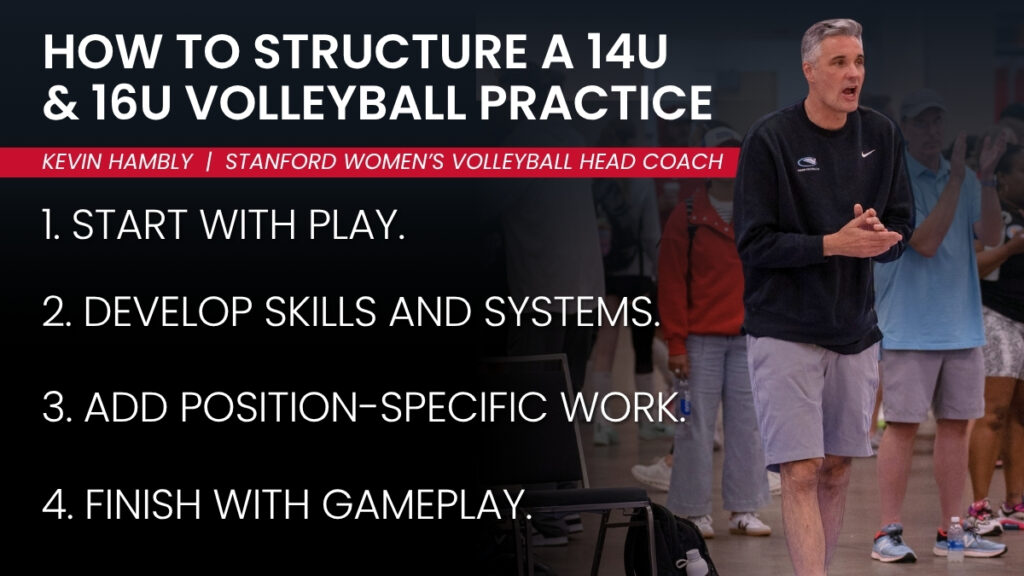
A typical 90-minute practice might include:
- Start with play. Get athletes competing and interested early, often through a constraints-led game.
- Develop skills and systems. Move into the technical or tactical focus of the day, including serving, passing, attacking, blocking, or system development.
- Add position-specific work. As athletes specialize, use portions of practice to focus on the skills and responsibilities of each position.
- Finish with gameplay. Spend as much time as possible playing volleyball and applying what was worked on earlier in practice.
Depending on the time of year and proximity to competition, Hambly might spend the final 25–30 minutes playing or extend that period to 45 minutes or more. The exact structure can change. The principle remains the same: develop skills in the context of playing volleyball.
What Should a 16U Player Have Before Moving On?
By the end of 16U, a player on the right developmental track should be able to handle a wide range of situations.
• They should be able to serve effectively and use different types of serves, pass, defend, attack a high ball, and understand how to position themselves on the court.
• They should also be comfortable when things don’t go according to plan.
• They can chase down a ball and keep it high.
• They can set a high ball when necessary.
• They can handle a tight ball and make a smart play.
• They can recognize what’s happening on the other side of the net and anticipate what comes next.
In other words, they don’t panic when volleyball gets messy. They know how to solve the game.
What Coaches Should Give Players Before 17U & 18U
Before athletes move into the final stage of youth development, Hambly believes coaches should leave them with more than technical skills.
• They should have a growth mindset, understanding that mistakes are opportunities to learn.
• They should still enjoy volleyball, even as pressure and expectations increase.
• And they should have experienced enough meaningful situations to know how to learn and adapt.
“The coach’s responsibility is to create and design drills and games that give them as much opportunity to learn and grow as possible.” — Kevin Hambly
The 14U and 16U years are about developing athletes who are increasingly capable of taking ownership of their own development.
Final Takeaways for Coaches & Parents
The 14U and 16U years are where volleyball development starts to become more intentional. Players begin specializing. Training becomes more position-specific. Systems become more important. Physical preparation becomes part of the process. And mentality increasingly separates athletes. But the foundation still matters.
The best 14U and 16U environments continue developing complete volleyball players while gradually teaching athletes how to specialize, make decisions, read the game, take care of their bodies, and learn from failure.
The biggest takeaways:
• Start specializing, but continue developing every skill.
• Gradually increase position-specific training.
• Teach athletes to make decisions, not just execute skills.
• Use game-like drills to create realistic situations.
• Help players learn to read and anticipate the game.
• Treat mistakes as information.
• Develop mentality alongside technical and physical skills.
• Teach athletes how to take care of their bodies.
• Keep practices challenging and fun.
• Give athletes opportunities to fail, adjust, and grow.
By the time players leave 16U, they should be developing more than a position.They should be developing their game
Continue Learning with Kevin Hambly
Want to take these concepts into your next practice? Visit Kevin’s Corner for additional coaching insights and free resources from Kevin Hambly:
• Kevin Hambly’s Coaches Corner
• 14U/16U Training Blueprint
• 14U/16U Practice Template