The concept of off-side skills is not new to sport. In basketball, a player dribbles with either hand. In lacrosse, the players must have the ability to shoot from either side. In soccer, the players have to be able to put the ball in the net using either foot.

In volleyball, however, we develop only one-handed hitters. Our game systems are designed for the right handed player, who make up more than 90 percent of those playing. That’s why our setters generally wait as targets to the right side of the court, so that the middle hitter (zone 3) and outside hitter (zone 4) are hitting “on-hand” as it is called.

Nevertheless, it is important for volleyball players to be able to hit with their nondominant hand. It’s not rocket science or hard to achieve. The thing that coaches have to do is give the kids time at practice to learn it. This should be done at a young age, and over the net in warm-up games (standing on the ground mostly), or in your form of “pepper,” just a minute or two every practice. The younger the player is when s/he gets good at using both hands the better the athlete will be in the air when it comes time to adjust once they have taken off in the jump.

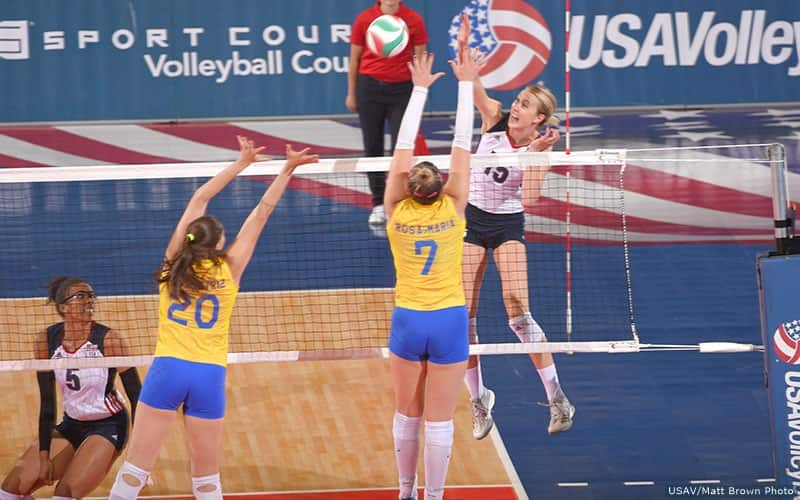
While offside hitting is important at all levels, it’s most important at the youngest age because younger athletes are the ones who make the biggest errors in judgment. The decision-making process takes place on the ground. A young athlete needs to be able to use the opposite hand as the ball drifts to the left side of the body. The first shot we teach is the across the body motion that would save the ball. The athlete will swing with the left hand and bring the ball from left to right over the net dropping the ball in zone 4 because of the radical angle. Any other angle would hit the antenna.

The Occurrence of ACL
This is how an ACL injury occurs. An athlete misjudges a ball. It’s match point or the middle of practice and the coach is screaming, “Hit every ball.” The athlete jumps and the only way to save it is by leaning way over to the left to hit the ball with the right hand. This action tilts the body to the left and creates a dangerous situation of landing, full force, off-balance over the left leg and therefore potentially blowing the ACL or damaging the ankle. As the foot lands, the knee takes the torque as the player finishes the landing process.

This happens more in the front row, with the nearby antenna dictating the reality of success or failure in getting the ball over the net, but it also occurs in misjudged back row attacks. Current research indicates that too many ACL injuries occur because of improper landing.

The scenario just presented demonstrates how this improper landing can occur more often than we would like to think in the sport of volleyball. The next scenario in making a save is when the athlete jumps in the middle and the ball is shot past the body during a shoot or faster set. In this case, a right-side dominant athlete could turn and hit the ball in the court with the right hand, which again would put the landing in a potentially awkward position. Alternatively, the player could hit the ball back with the left hand. This isn’t an actual hit but more of a tip to an open space. Based on realities of the game and what I see happen in a lot of misjudged balls, this is an important skill to have.

A final scenario occurs when a right-handed player goes running in on the right side of the court, zone 2, and realizes that the ball is too far over to the left. Normally what the athlete does is rotate to their left and hit the ball with the right hand because on that side, the player is still hitting into the court. As it is totally the opposite of what is seen in our zone 4 outside hit we presented in the first scenario, the need to hit the ball with the left side is diminished greatly in this instance.

Prevention Techniques
Learning to hit offside can be a simple process. Two athletes, each right side dominant, stand at the net on opposite sides. The first athlete turns the right shoulder to point at the athlete on the opposite side. The ball is set to the left side of the body and the athlete swings across the body, left to right, bringing the ball over to the athlete on the other side. The athlete on the other side with the right shoulder facing his counterpart on the other side hits the ball back. The two trade off their non-dominant hands.

The bottom line is the coach needs to develop both sides. In playing pepper, over the net pepper, or in game that might be played one to two minutes of non-dominant hand, hitting should be done until the skill becomes automatic. Making it automatic is important because the players, for the most part, don’t realize that the solution is reached after take-off. If athletes always knew where to jump they would jump in the right place. For left handers, this non-dominant development is even more important because when they hit to zones 3 and 4, they are often set the ball as if they were right handed and the set is delivered too far to their right. As a result, left-handers develop their non-dominant (right) hand earlier on because they are constantly getting right-handed sets. The most common result is the lefty will hit to zone 2 on the right side of the court. I’ve experienced knee injury first hand.

When I was 19 I received a set put wide to my right on the right side and couldn’t do anything but hit the ball with my left hand (I’m left side dominant). To keep the ball in play over the net, I leaned far to the right in air, landed one legged on my right leg and blew my right knee. So, for left-handers more time should be spent working off-hand hitting techniques because the error to a right-hander is usually done by the player making an error in judgment. The error for a left-hander is usually done far more often, as setters are all used to setting right handers. If they hit zones 3 and 4 they are getting set more often as if they were right handed by the setter who doesn’t make the slight adjustment to get the ball to the players’ left shoulder.

Landing Considerations
As I’ve stated before, recent research has indicated that ACL injuries may occur because of improper landing. The problem occurs when an athlete is reaching out and hitting the ball over the left side of the body. How long is the athlete in the air? United States Olympic Committee research shows from a half to two thirds a second overall with .25-.32 seconds to contact and then .25-.32 seconds to landing. Therefore after the hit, the athlete will too often land before s/he has a chance to readjust the body to land with good technique. There just isn’t enough time to adjust otherwise.

So, by programming athletes to hit off-hand rather than attempt a dominate hand hit, the landing issue takes care of itself because when hitting with the non-dominate hand the landing technique is not compromised and the landing is done with good vertical form. In the end, we need to give all players the tools to solve these judgment errors, which happen with little time to adjust, by training the movement first one the ground, and then being able to use both arms in the air as needed.

The importance in winning the learning competition is paramount. For more than a decade in this blog, I have used titles like “STOP Teaching [Blank]” as a way to get coaches to think about change. Some coaches think I am calling for an absolute ban on whatever I am observing, so I started using the word “limit” to help others really ponder the intent of the message. In the end, it's about efficiency and effectiveness in learning.

When drills are the primary source of learning, players aren’t actually learning how to play volleyball. More effective learning takes place in the chaos/randomness of practice and games as the brain is forced to exit the groove of expectation and problem-solve in novel situations. It comes down to putting the constraints in various ways in small-sided games like doubles, then moving toward the 6x6 game. Remember, contacting the ball is how we develop motor skills, not watching someone contact it.

Please consider this quote from one of the greatest tennis players of all time, Rafael Nadal:

“You might think that after millions and millions of balls I’ve hit… reliably hitting a true, smooth clean shot every time would be a piece of cake. But it isn’t. Not just because every day you wake up feeling differently, but because every shot is different. Every single one. From the moment the ball is in motion, it comes at you at an infinitesimal [sic] number of angles and speeds, with more topspin, or back spin, or flatter or higher. The differences might be minute, microscopic, but so are the variations your body makes – shoulders, elbows, wrists, hips, angles, knees – in every shot. And there are so many other factors – the weather, the surface, the rival. No ball arrives the same as another. No shot is identical.”

Volleyball is perhaps the most random sport in the world. Not only are we playing with 11 other players on a small space, but we rebound the ball off our imperfect bodies, not a specially manufactured device like in golf or tennis Each contact is unique and requires proper reading of the game action prior to contact to be in the right place at the right time for success. Effective and efficient learning includes the chance to forget and re-remember, not to be drilled into a repetition nightmare.

When we fail to use the net while learning, we again are learning less effectively. Training on the same side may look better, but it removes the visual stimuli that is always present in a match and prevents us from experiencing volleyball in reality. Learning with the net is learning most efficiently.

When I watch X Games competitors perform a variety of tricks, I know that they've learned them all without a single drill and essentially without a coach, I and admire their creativity and tenacity. When I study box lacrosse and pond ice hockey in Canada, the players learned in small-sided games from the game itself. During next year’s Olympic Games, you will see 3x3 basketball and rugby sevens (not the 13- or 15-player variant). Doubles and even triples volleyball are the most effective and efficient way to learn our sport as long as time is then allowed to play the 6x6 game with all the tactics, systems and options. I will be moving more to these smaller-sided games for training in both indoor and outdoor, and share this quote from U.S. Women’s National Team Head Coach Karch Kiraly as to why:

“The beach game taught me great lessons about how to elevate the play of my teammate, or teammates, and how to anticipate and expect the ball so much more than the indoor game ever could. It taught me — even forced me — to be a much better all-around player. That allowed me to help our USA Olympic Team in many more ways than I ever could have otherwise."

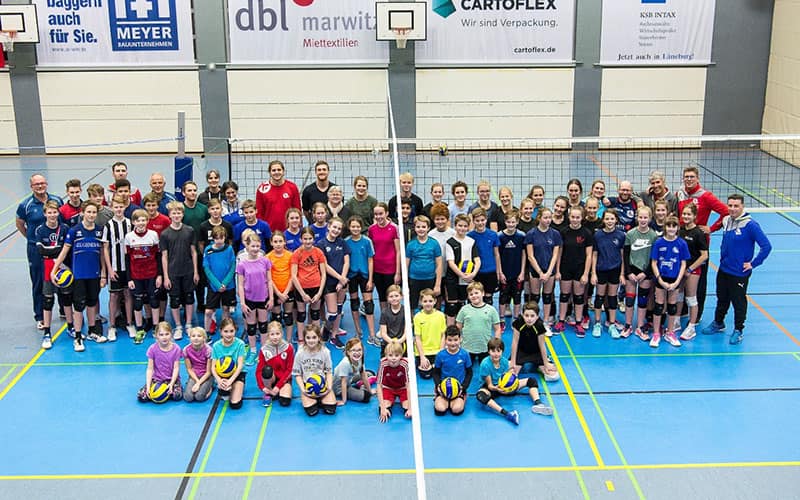
John Kessel with youth players in Germany.

Olympic Day is later this June, and USA Volleyball programs are welcome to participate by getting their free toolkit.

As school winds down, camp season approaches, and siblings have a chance to learn with each other, I wanted to share some ideas on giving new players the joy of playing our unique but challenging sport.

Volleyball should be a game, before it becomes a sport.

Too often, those who love our sport unintentionally start beginners (of any age) based on sport and not joy. P.E. teachers, who are often the first to introduce the game to kids, do the same, as do so many clubs and USOC Member Sports Organizations. Unintentionally, the first chance to discover the fun and challenges of our game are done in a less-than-effective way. Accordingly, I have a few suggestions for those first few hours of learning.

Start with "Superhero, Superhero, Spike"

Or call it “unicorn, unicorn, swing” or some other clever way to focus on overhead pass/set/attack. The key is to not teach the forearm pass until the fourth skill in the process. Many traditionalists will say “can’t pass, can’t hit,” and thus around the world we see these well-intentioned leaders introduce the game of volleyball first with the forearm pass. Please consider changing your introduction to what kids already have: some form of eye-to-hand coordination and not eye-to-forearm skill.

In addition, as most kids are forced to use an adult ball, small-armed children are experiencing actual pain from forearm passing -- this is not the introduction we should be making.

When kids get to slap/slap/spike, or, in some programs, grab and hold contacts one or two (as in forms of newcomb/smashball), they begin their joy of discovering volleyball. The technical part comes as the kids decide to keep playing the game. Then we get to ball shaping, better ball delivery, back setting (start early using the D set so they can hit confidently from both sides of the net), and hitting from anywhere on the court.

Start hitting from well off the net every session

Too many coaches put young/short players right on the net when they first start spiking, and the result in form and success is poor. Thus, another key for new players of all ages is to start by teaching the higher level back row calls, starting with the lowest set on the USA national teams we call a “Bic.”

Walk into schools and say, “I am here to teach you the joys of volleyball,” and then explain that these Olympic-level sets from the back row are known as A | Pipe | D, plus the lowest set in the pipe zone is a “Bic.” So, let’s all hit some Bic sets!

Not only do you have more success, you will dramatically reduce at-the-net injuries as the variance width of both the setting and the hitter awareness in jumping/landing is very broad. By staying off the net as they learn to jump at the right place and time, and as setting gets to be more accurate, you let players safely develop from beginner to more advanced.

Help players learn to keep the ball well away from the net and that “setting” can happen anywhere on (or outside) the court.

Teach a version of torque serving before they leave

Before you send them away, and before any forearm passing, give them the chance to do one skill they can practice alone – a serve.

Underhanded certainly is one option for the youngest. I prefer teaching a sidearm, or even better, overhead torque serve. Servers get over a third of their power from the shoulder turn/torque. Standing sideways at their start allows them to learn/feel this turning power. Then, when they face the net more, they still have this core movement as part of their serve.

Many youth and adults don’t realize they are not fully using torque, so starting with it is essential. Peer pressure to look like other servers at the higher level, including jump serving, will likely bring them to the more traditional overhead serve. As you can see from this video, I suggest starting with, as these under 10-year-olds show, the jump torque serve. It’s fun, it’s in their control and they can do it on their own.

Stop standing in line

This goes for just about any level of training, but for beginners, the last thing we need to do is be bored in our first experiences. I contend that boys dislike the game as they first learned it in P.E. playing with 24 classmates, 12 on a side, and one ball. This form of tennis may be fun for singles, but not for a dozen on a side … there is a reason there are SIX hoops up in the gym. Small-side courts and doubles or triples games vastly increase the learning by doing.

Long lines are boring and far less effective in learning. We learn athletic skills by doing, not watching. Imagine learning to ride with one bike and 12 kids, or driving a car after only watching someone else drive for years. You still have no clue how to drive until you start.

Also, learn to play over a net. Ribbon, rope or the USAV Four-Nets-On-a-Rope are all options for you. This same flyer includes the educational USAV Beach Ball for youth, so you can give every kid a ball to take home for just $1 each.

This photo at the top of this article shows the end of a clinic I did for my son Cody’s SVG Luneberg pro team in Germany this year. With my daughter McKenzie along, we ended the youth clinic showing how to better use the wall and how to quickly set up eight short nets on two full courts. We quickly had about 50 kids in pairs pass/setting and hitting bics and jump slide serving.

Later that week, I watched my son play in the same gym in front of a sellout crowd and be named match MVP. It started by me knowing the WHY of this question: Four kids and one ball, what happens? They play. Four kids and one ball and an adult, what happens? They drill.

Introduce recess, wall, basement and tennis and racquetball games

You can teach every beginner the kind of effective “homework” they can do until they experience the game. They can play Winner Stays On/Loser Becomes the Net games they with just three or more players at home, with friends in the driveway (coed is fine), and at recess at school. All they need is a ball.

Show them effective ways to use a wall by hitting over a mark on the garage door that is net height. You can also simply play doubles against the wall with three hits (alternating contacts) and track how many times in a row you three-hit, then hit over the “net,” This is a key example of cooperative scoring as seen in our IMPACT coaching manual.

There is likely nothing more intense and fun than a game of balloon ball played in the basement or living room (wherever the damage of a fast-flying balloon is less).

Balloon ball is also an excellent place to begin learning to play sitting volleyball. Consider not only the beach ball noted above, but for more durable program use young players can start with the Molten First Touch series (I prefer the 140g option for versatility) or the 12 and under Lite series at 240g (adult balls average 270g, about 10oz).

For those not able to play in their backyard or driveway, play doubles in a racquetball court where the ball never gets away, or at your local tennis court. Simply sidewalk-chalk the lines and string up your “net” on the fence, which also serves to keep the ball around better than most other places. To see other ways kids have created placed to play, see this classic The Game Will Find a Way blog.

IMPORTANT: If you want to help get your schools to give a good start to all in volleyball, I urge you to suggest to the teachers (math, science or P.E.) at those elementary and middle schools who are pipelines to your program to order one of the volleyball STEM kits. They likely have STEM grant money and can round things out with the volleyball STEM kit, which after being used for beach and ParaVolley, can then be given to the P.E. teacher who will get nearly 20 volleyballs to use. Check the options out at www.stemsports.com. The kids, the teachers and your program’s future will be glad you did.

Should you have any other effective ideas to give novices a great start and love of our sport, please share them below, and thanks for growing the game together.

Looking for some easy tips to pass on to your players? Here are six tips from top coaches and players to remind you of some core techniques.

John Speraw

Head coach, U.S. Men's National Team, UCLA

Understand that you’re always involved in the play. When the ball gets set to the other pin hitter, I bet you 90 percent of athletes stop and watch their teammate hit the ball.

Invariably, the hitter coverage that is most needed is that person, because the ball has a funny way of finding that side of the court. And that person isn’t in an athletic enough position to react. That’s a mistake you should never make.

I tell people, ‘If you want to stand around, go stand around on the bench.'

Bill Neville

Longtime coach, founder of Nevillizms

Go for every ball rather than premeditating whether or not it is playable. The only way to know if a ball is unplayable is if you go all out for it and don’t get it. One great save that leads to a point may be the difference between winning and losing, so go for every ball. Make it a habit to give maximum effort every time.

Christa Dietzen

Former U.S. Women's National Team middle blocker, 2012 Olympic silver medalist

Use names when identifying the teammate you want to make the play instead of using terms like “go” and “you.” We have names for a reason, and it can do wonders with communication on the court!

Alisha Glass

Former U.S. Women's National Team setter

Never be afraid of making mistakes, as long as you learn something from them. Mistakes can be a positive tool, as long as you learn something from them.

Volleyball is such a cool sport that is constantly evolving, always giving athletes the opportunity to learn and grow. With any sport, there are times that fear creeps in; serving at 25-25 in a championship match, taking an aggressive swing when the game is on the line, stressing over a setter/hitter connection, even trying something new in terms of technique in practice.

Embrace those moments, be fearless, because either you’ll triumph, or you’ll make a mistake from which you can learn, and you’ll become better for the next moment that comes along. It’s a win-win!

Erik Sullivan

Associate head coach, University of Texas; two-time Olympian

Dig the ball so it stays on your side of the net. When you’re digging, be safe and make your target 6 to 10 feet from the net and let your team have a chance to take a swing in transition. Dig the ball high and to the center of the court so your setter can make the best set possible and give your team the best chance to score a point.

Anna Collier

Head beach coach, USC

Keep talking to your partner. The key to the beach game is communication. No matter how in the tank you or your partner may be, you will never work out of it by going silent. Keep your body language positive, too. It’s easy for negative emotions to fill blank space. So when things go south, keep your chin up and talk it through.

Recently, I watched my son, Cody, play in a couple of matches for his pro volleyball team in Germany.

What I loved most was the range and adaptability he showed as he was attacking and blocking. He was MVP of the match, scoring as many stuff blocks as the rest of his team combined. He serve-received as many balls as the other team’s libero and at a higher success rate. He killed twice as many balls as any of the other players on the court, from both the back and front row, and both sides of the net. He also made some key digs from the back row.

In the words of Hugh McCutcheon on what he sought for the national team: “We want players who are good at all six skills, and great at one or two…”

So how did a kid from Colorado get so good at blocking? Well, I can tell you this, he never blocked from a box or blocked hitters who were on a box. He blocked live hitters. How did he get to be good at serve reception? He played a lot of doubles growing up and never threw a ball to a setter; he always received, then hit. After all, the ideal hitting drill is a pass/set/hit drill.

This, however, is a blog about hitting more effectively, and I am writing this not to players like my son who can touch over 12 feet high. I am writing this to Claudia Garay, a 5-1 hitter on a high school team I coached who was our best hitter – and better than every other taller player.

I am coaching 13s, and a lot of 12s on the 13 team, and at every practice, everyone hits, sets, serves, serve receives and digs. Every player sets and hits at each practice in front/back format.

This leads to my first point to help your hitters. Most teams focus on hitting left side all the time, and rarely, if ever, hitting the right side. Spending half your time hitting from zone 2/the right side means you are developing far more effective hitters who can deal with a ball falling into their sweet hitting spot from both on and off hand.

We start every hitting session with the back row playset calls of our national team – A, Pipe/Bic and D. Every player’s first backset is a D, not one tight to the net, a three-meters-off-the-net backset, so we start with making the positive mistakes first. With the youngest, we start with the Bic, aka the back row quick, which we ask to consistently be the height of the antenna or one meter above the net band. It is harder for less experienced and younger players to set the higher sets, but even our youngest/smallest player can consistently now set a front and back set meter ball.

Hitting From Way Back

We spend a large amount of time hitting from not only back row but from five, six and even eight meters back. You simulate a “bad” pass that goes well off the net, and in front back format, the bad passer backs up “behind” (further back from the net) where the ball is falling and calls “Sick!” (that is a play on words of a bic set), and their teammate sets them a “bic” or meter-high set for them to jump and attack.

You read that right, I want my 13s and younger to jump and swing from eight meters back, not stay on the ground and forearm pass a free ball over for the third contact. This ball flight teaches (just like a back row attack) how not to swing into the net but to learn that important positive over-the-net arm swing.

Hitting Over the Block

The pic of Cody hitting over the two-foot high block (right) made me realize another of his skills that any player OF ANY SIZE can emulate to become a better attacker: hitting with range, especially OVER a block.

In our gym, there are times we put the net up to the men’s height and work on better learning the timing/arm swing it takes to hit over that “block” – equal to an eight-inch/hand-high block that is the max block of the majority of our opponents, which is nine meters wide.

Learning how to hit effectively over a block wreaks havoc with the opponent’s defense which relies on the shadow of the block to not have to worry about hard-hit balls falling into that zone. It is not the arm swing learned in pepper or in traditional wall spiking. It can be learned properly against a wall, even as homework.

Hitting Range

Then there is the other part of range/hitting effectively: to be able to hit both cross body and wrist away shots from the right and left side of the court.

Again, while these shots are understood well by hitters who train in zone four/left side, we simply do not have enough players in our sport who are good at hitting line (with wrist away) and inside the three-meter line (with the cross-body swing) from the right side/zone two. Most players hit where they face, in pepper, practice and competition (as the cross court has the most court available), thus most hits go the way they are looking.

To be more effective, we simply need to spend more time practicing not hitting where you are approaching.

We all should heed the words of this Russian scouting report from the 1968 Olympics about Jon Stanley, the father of 2008 gold medalist opposite hitter Clay Stanley:

  • Never hits where he looks
  • Always hits where you aren’t
  • Unstoppable

Hitting Off Speed

Learning to hit off speed is another technique. Most athletes hit on a good set but hit off speed/tip on a bad set. I believe it is important to learn to hit with range and options on the bad sets and every now and then tip/off speed on a good set.

That is not what usually happens in a game and so you are becoming a more effective hitter. Do it in warm-up, in over-the-net pepper, and in hitting grills. Remember to not tip/off speed only where you are looking; hit tips cross body and away from your body.

Hitting Off the Block

I would guesstimate that in the 2016 Rio Olympic Games, some 15 percent, likely more, of Taylor Sanders' attacks as an outside hitter would have flown out of bounds by more than 100 feet…only he scored the point by hitting off the top of the blockers' hands.

The smaller you are compared to your blockers, the more important being able to hit off the top and the sides of the block become. Of the two shots, cross or line, I first suggest hitting off the side of the outside blocker that sends it to the line/outside the court on any deflection. When you swing cross court, you too often will be roofed in, vs you can be roofed, but if it deflects past the line, over the net or on your side it is a point for you.

Tied into this concept is teaching and knowing when to wipe out, from both the left side -- a press into the hands and radical cross body shot for a right hander; or from the right side – a press and radical wrist away shot for right handers. Some know how to do it from the left side, few are good from their off hand/right side of the court. Practice it standing to experience the motion (sending the ball into a near wall so you need not chase the wipe shot across the gym floor), then learn when on a tight set, to a) jump safely away from the center line and  b) reach and press into the blocker then wipe out of bounds.

Without a blocker present, these shots in practice would look like errors, which is why we need to hit against blockers all the time if our level of play has blockers confronting us. Too many hitters develop false confidence pounding the ball, then get roofed or go timid when the reality of a block is present. The block is a tool to use to be a more effective hitter.

Hit With Your Other Hand

Finally, spend a little time in practice learning to hit with your nondominant hand. No good coach in soccer, basketball or lacrosse would spend 100 percent of their time just training the dominant hand and foot, but in volleyball that is normally the case.

You will become a more effective hitter if every practice you let yourself hit a few shots with your nondominant hand. You don’t need to be ambidextrous, but you must know how to use your “other” hand/arm to save and place balls in the chaos of the game.

The biggest error I see is that players and coaches want hitters to look good, so they ignore the net (last time I checked every spike must go over a net) and the reality of the block (at the higher levels), and they fail to link the flow and reality of the game by using hitting machines and coach tosses. The players look good in practice but never learn how to jump at the right place and time. 

My 13-2 team has no one who can get above the top of the net with at least their hands to “block,” so we weave swim noodles into the net to be like an 8” or higher “blocker” and teach them to be better diggers.

Every player, regardless of size, can hit over any net or block, with range, from all over the court (though the littles have to be off the net to have a chance). We just have to learn in reality. 

Most people recognize being an official is a difficult (and often thankless) job. Yet ironically, many volleyball parents, coaches and athletes insist on making this job even harder by shouting ridicule and criticism the official's way.

While fans empathize with an athlete who makes a mistake, officials (who are sometimes not much older than the athletes) are more likely to be condemned, demeaned and chastised. Teaching respect for officials doesn’t necessarily mean encouraging blind obedience, but rather, how to self-advocate, take responsibility for your own actions and overcome adversity.

A Crisis of Disrespect

It’s probably no coincidence that as society’s win-at-all-costs attitude has increased, youth sports organizations are facing a severe officials shortage.

While incidences of violence against officials were extremely rare, they are now occurring more frequently: in 2013, a Utah youth soccer referee died after being punched in the head by a player upset about being called for a foul.

A few years later, two high school football players in Texas received national attention when they blindsided a referee during a game.

While those tragic incidences represent the extreme, young athletes can see professional athletes and coaches verbally confronting officials on television almost every night.

Even at the youth sports level, it isn’t difficult to find instances of players, coaches and parents verbally abusing officials.

If we’re being honest, most parents have probably – even unintentionally – let a “You’ve got to be kidding me, Ref” come out of their mouths. The ease with which these comments emerge makes it more important to increase awareness about how parents, coaches and athletes treat officials.

Lessons for Referee Respect

Like with sportsmanship and teamwork, respect for officials is an important value that needs to be specifically taught to athletes, parents and coaches. However, even though there are officials at every game, there is virtually never a direct conversation about the expectations for respecting officials.

Teaching respect for officials doesn’t have to be hard, hokey or time-consuming, as long as you can remember these lessons.

Officials Have More Training Than Players or Spectators

No matter how experienced or knowledgeable an athlete or parent is, it’s important to remember officials have specific training in the rules of the game, how to observe the game and how to make difficult calls. They are also often in a better position to see the play, especially compared to parents on the sidelines or in the stands. If you’re still convinced you can do a better job, leagues are always hiring.

More Focus on the Officials Means Less Focus on the Game

There are many aspects of sports that are unpredictable and out of a player’s control. However, there are some things an athlete can control.

Players, spectators and coaches can’t control officiating, but if players are overly focused on how the officials are calling the game, they are likely less focused on playing the game to the best of their abilities.

Similarly, coaches should advocate for their team, but focus more on instructing and guiding players than haranguing referees. For parents in the stands, you could spend your time focused on the officials or spend that time focused on watching and encouraging your young athletes to do their best with the one thing they can control: their own performance.

Officials Should be Treated Like Coaches

One of the ways coaches can model respect for officials is to make an effort to personally greet officials before the game, just as you would the coach of the opposing team. And while it may not be practical for every player to greet the officials, encourage captains at the pre-game meeting or coin flip to introduce themselves to the officials.

These efforts help turn nameless, faceless officials into people, particularly people to be respected, in the eyes of young players.

Yelling at Officials Models Poor Communication Skills

For parents and coaches, it’s important to think about what yelling at officials teaches young athletes. Youth sport advocacy organization Play by the Rules has outlined several different ways yelling at refs hurts kids by communicating to them that:

  • Mistakes are not acceptable
  • There’s no need to take accountability for your own performance when you can blame others
  • It’s acceptable to disrespect an authority figure whenever you disagree with their decision
  • Even though it’s rude, disruptive and distracting to others, yelling is acceptable behavior

Try It Before You Criticize

Having athletes and parents try officiating during scrimmages at practices is a great way of illustrating the difficulties referees face. It’s the old “walk a mile in someone else’s shoes” lesson, but it’s effective for helping parents and athletes be more empathetic toward referees.

Remember, It's Just a Game

No missed call during a volleyball match is going to make or break an athlete’s career. Youth sports are an environment for learning about and falling in love with sports, not heaping pressure on athletes, coaches and officials.

And in the off-chance a player, coach or parent makes a mistake and is disrespectful to an official during the game, make an effort to resolve the conflict after the game with a face-to-face conversation with the official. This helps illustrate to young athletes that after a conflict with another person it is important to take responsibility for your actions and make amends with the other person.

About TrueSport
TrueSport® is a grassroots movement born and powered by the experience and values of USADA–the U.S. Anti-Doping Agency. The TrueSport® mission is simple and bold: to change the culture of youth sport by providing powerful educational tools to equip young athletes with the resources to build the life skills and core values for lasting success on and off the field.