

LIMIT Your Coaching…
As I have found, some of the coaches most needing to read the science and ideas in this blog are simply not reading the ideas in their entirety.
Resources for
Follow USAVolleyball


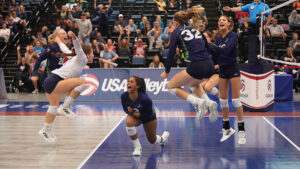 USA Volleyball Education is focused on improving developmental and educational opportunities across the sport of volleyball from grassroots to the national team level. Our goal is to provide the opportunity to access, complete and apply high-quality information and methods in the technical, tactical, physical and emotional aspects of the game for athletes and coaches while providing training, support and resources for other key stakeholders including officials, parents and clubs.
For years, the focus of volleyball in many areas and across various levels shifted to a mindset of winning at all costs.
What we now know is that the most successful teams in the world have developed a model of training and a culture that supports a holistic approach to athlete development which not only sets them up for competitive success on the court, but values and emphasizes the important of athlete health, well-being and long-term involvement in the sport.
The USA Volleyball Development Model was created based on the idea that volleyball in the U.S. could be taught differently, resulting in long-lasting positive outcomes across all measures of performance while keeping kids involved and loving the game longer.
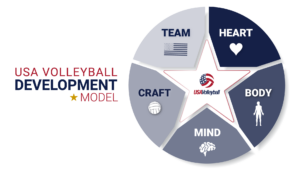
The five pillars of the USA Volleyball Development model provide the basis for a holistic approach to the core elements that are vital to supporting development at every level and across age groups.
USA Volleyball Education is committed to providing support for the volleyball community with a role-based approach to education and training. Whether you’re planning practices, cheering from the stands or making the right call, we provide the tools and resources to help you succeed.
The 14U and 16U years are where volleyball development starts to become more intentional. Athletes can begin specializing by position, but they still need to develop as complete volleyball players. At the same time, players should begin taking greater ownership of their recovery, physical development, decision-making, and mentality.
As I have found, some of the coaches most needing to read the science and ideas in this blog are simply not reading the ideas in their entirety.

I simply would like to ask everyone reading this blog to share, as I am about to, their best practices, other sport successes and brainstorming thoughts on how to give boys 5-18 years old a chance to make volleyball their sport for a lifetime.

Karch Kiraly blogs about maintaining composure on the court.

OK Volleyball Thinkers. I need some help in creating a ball for young kids. About 20 years ago I created a “balloon ball”

Over a decade ago, I created a program with USA Volleyball, our regions and our amazing clubs to donate just one of their used volleyballs at the end of their seasons, to give away to other programs around the world that are less fortunate.
… and start working much more on improving what you can control as a coach to increase your players learning of volleyball skills.
Okay, this version of my STOP series is likely to be a tough one for many coaches, but its truth is well founded in science, just not implemented well in our teaching practices. I just watched perhaps my 2,000th “drill” on YouTube, as I seek to find any new ideas that others have created to help us grow and develop our sport.
Over the weekend I got an email from a coach/friend from another country, with the subject line “Needing Advice” – In short, his daughter’s team won every game/set she got to play in, and lost every one she did not, yet the coach played her less as the tournament went on.

"She understands that it is even when a paycheck is included, that it is more than just winning games that she is doing with her players, and focuses on team building through off court activities."
We are back with another one of our STOP series, in this case a look at a practice that I hope can be changed in creative ways, to allow many more kids the chance to make volleyball their sport. This challenge to create programming that gives everyone wanting a chance to play the game, comes simply from the core of Long Term Athletic Development (LTAD) – to keep as many athletes playing a sport as long as possible.
BUT NOBODY IS GOING TO OUT HUSTLE US…. That has always been my motto, so much that some of my teams have heard it so many times in huddles they say it in their sleep I bet.

Evaluating your diet based on your current performance stage

For over 30 years, my mom taught first grade. I would visit her many times at school while she taught over the decades, starting from about the same height as the kids in her class, to being over six feet tall and towering over the kids, my mom, and their little chairs. What I remember from her teaching has colored my coaching, in the principles I learned from her, which would apply to coaching any sport well.

One of the core concepts of motor learning is to increase the opportunities to respond. In our USA Volleyball IMPACT course, we call this increasing the contacts per hour.

The two most important skills in our sport are reading (as in anticipation, not hunkering down with a great book, though that skill is VERY important in life) and learning.

I love to read and learn from people much smarter than me. Dr. Daniel Kahnemann, Jon Brockman (visit the www.edge.org often and you will be thankful even if your head spins at times), John Wooden, and Albert Einstein are examples.

Three Outlet Adapter – This leads my list because of the technology that we all use to be better teachers. Carrying a one to three adapter makes you a savior to one other fellow traveler, as you ask permission to change one outlet to three, one for the lucky first arriver, one for you, and one for that other fellow coach or traveler desperately needing a power source.

Olympic coaches and athletes talk about the do's and don'ts for on the court
I recently was at the NCAA Finals for Women’s D1 and four words jumped out at me that I have always found of importance, but which were being repeated in session after session. To hear others using these four words in genuine ways, makes me think we have turned a corner in volleyball.


